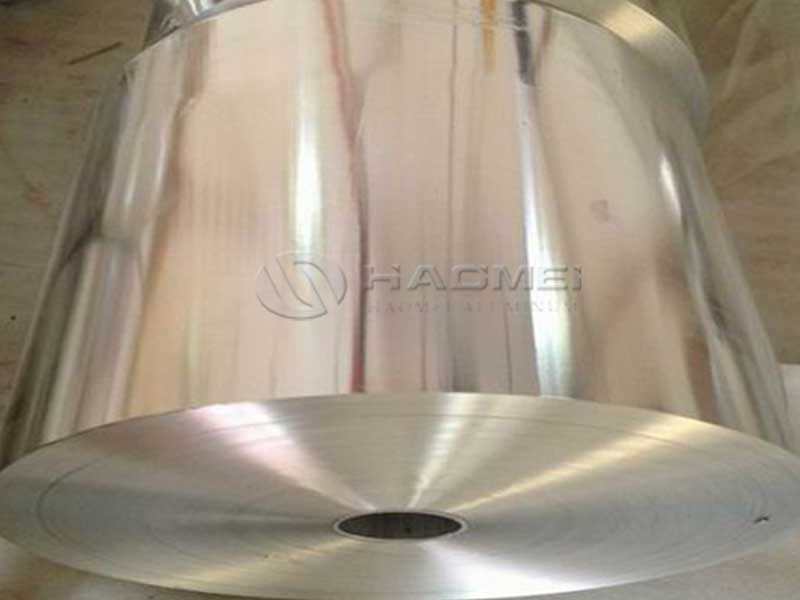
3003 Aluminum Foil for Capacitor Foil
3003 Aluminum Foil for Capacitor Foil
Capacitors are often discussed as if they were purely electrical components, but the most revealing way to understand them is to treat them as miniature chemical factories wrapped in metal. In an aluminum electrolytic capacitor, the "dielectric" is not a plastic film inserted between plates; it is a controlled oxide that grows from the aluminum itself. That means the quality of the aluminum foil is not a background detail-it is the stage on which the dielectric is formed, etched, repaired, and stressed for years.
From that perspective, 3003 aluminum foil earns attention not because it is the most exotic alloy available, but because it sits in a useful middle ground: it offers stable forming behavior, consistent mechanical handling, and practical cost-performance for a range of capacitor-related foils, especially where the design emphasis is on manufacturability, robustness, and steady electrical behavior rather than absolute maximum capacitance per volume.
Seeing 3003 as a "process alloy," not just a material
3003 is an Al–Mn alloy (with minor Fe and Si). In capacitor foil production, the decisive question is not only conductivity; it is how the foil behaves across a chain of processes: rolling, slitting, cleaning, etching, anodizing (forming), and winding. Each stage can amplify minor instabilities into major yield losses.
The manganese addition in 3003 promotes a microstructure that can be more tolerant of processing variation than ultra-high-purity aluminum. It tends to stabilize grain structure and improve resistance to tearing during tight-radius winding and high-speed handling. In practical lines, that can translate into fewer edge cracks, less web breakage, and better tension stability during etch and rinse stages-issues that directly affect delivered capacitance consistency and leakage performance.
At the same time, 3003 remains sufficiently conductive for many capacitor-foil roles, particularly when the application is not pushing the extreme limits of ripple current or ultra-low ESR. The foil's "electrical adequacy" is only one side of the coin; the other is that it can be processed reliably into a surface that forms an oxide layer with consistent thickness and defect rate.
Chemical composition and what it implies for capacitor foils
Typical chemical composition limits (wt.%) for AA 3003 are shown below. (Actual supplier certificates may vary slightly depending on standard and customer agreement.)
| Element | Composition (wt.%) |
|---|---|
| Al | Remainder |
| Mn | 1.0–1.5 |
| Fe | ≤ 0.7 |
| Si | ≤ 0.6 |
| Cu | 0.05–0.20 |
| Zn | ≤ 0.10 |
| Others (each) | ≤ 0.05 |
| Others (total) | ≤ 0.15 |
Temper and condition: where mechanical truth meets electrochemical reality
Capacitor foils are typically thin and highly worked. Temper choice affects flatness, pinhole behavior, and the ability to survive subsequent chemical treatments.
Common tempers for 3003 foil include O (fully annealed), H14, H16, and H18, as well as intermediate custom conditions. In capacitor-related foil processing, fully annealed material is often favored when deep etching and high surface development are required, because a recrystallized structure can etch more uniformly and reduce localized "hot spots." Harder tempers can improve stiffness and handling, but may raise the risk of edge cracking or induce less desirable etch patterns, depending on the etchant chemistry and current density.
A practical way to think about temper selection is to match it to the dominant failure mode in your line. If web breaks and edge fractures are the limiting factors, a softer temper with better ductility may win. If telescoping, wrinkling, and poor winding geometry dominate, a slightly higher temper that improves stiffness can improve throughput and downstream capacitor assembly stability.
Etching and forming: 3003 as a controllable landscape
Capacitance in aluminum electrolytics is increased by etching the foil to create a vast internal surface area, then anodizing it to grow Al₂O₃ as the dielectric. While high-purity aluminum is commonly associated with maximum surface development, 3003 can be compelling where a controlled, moderate etch structure is desired. It can help produce a more conservative pore morphology that is less prone to catastrophic oxide thinning under ripple stress.
Forming behavior depends strongly on surface cleanliness, rolling oil residue, and inclusion control. 3003 foil intended for capacitor use should be supplied with strict pinhole limits, consistent roughness, and low residue. In production, alkaline cleaning and de-smutting steps should be tuned to avoid over-attack on Mn-containing phases. A line that is dialed in for pure Al may need slight adjustments in etch chemistry, temperature, or current density to produce equivalent uniformity on 3003.
Implementation standards and typical technical expectations
For procurement and qualification, 3003 foil is generally produced and inspected under widely used aluminum standards, then further qualified by capacitor manufacturers' internal specifications.
Common reference standards include ASTM B209 (aluminum and aluminum-alloy sheet and plate; often referenced for general chemical and mechanical compliance) and JIS H4160 / EN AW standards (regional equivalents for composition and temper definitions). Capacitor foil typically goes beyond these with additional requirements such as:
Flatness and shape control suitable for high-speed winding
Tight thickness tolerances and low gauge variation across width
Strict pinhole control and surface cleanliness criteria
Defined surface roughness windows to support repeatable etching/forming
Edge quality requirements to prevent slitting burrs from initiating tears
The most important "standard," in practice, is repeatability: the same etch recipe should yield the same capacitance distribution from lot to lot. 3003 can be a strong candidate when your plant values stable processing more than absolute peak surface area.
Where 3003 aluminum foil fits in capacitor applications
3003 is not typically positioned as the default for the highest-capacitance etched anode foils in ultra-compact, high-voltage electrolytics-those often rely on very high-purity aluminum. Yet 3003 has meaningful roles across capacitor construction and adjacent foil needs:
Cathode foil and current-collection layers
In many electrolytic designs, the cathode side can benefit from a foil that is mechanically robust, processes reliably, and accepts surface conditioning without excessive brittleness. The slightly higher strength of 3003 compared with pure aluminum can improve winding integrity and reduce deformation during assembly.
General-purpose electrolytic capacitors emphasizing durability
In industrial capacitors where vibration, thermal cycling, and long service life are prioritized, the mechanical stability of 3003 can support consistent contact pressure and lower risk of mechanical damage to the oxide interface over time.
Foil components beyond the etched anode itself
Some capacitor formats include tabs, lead-out foils, or structural foil layers where formability, weldability, and consistent behavior during impregnation matter more than maximizing etched area. 3003's balanced property set can simplify sourcing and fabrication.
A distinctive advantage: designing for yield, not just performance peaks
If you view capacitor foil selection as an optimization problem, it's tempting to chase the highest possible capacitance per gram. But manufacturing economics often reward the alloy that produces the narrowest distribution: fewer outliers in leakage, fewer shorts from pinholes, fewer winding defects, fewer etch nonuniformity events, and fewer lot-to-lot surprises.
3003 aluminum foil can be understood as a "yield ally." It trades some of the headline-grabbing electrical extremes for a steadier process window. In factories where uptime, scrap reduction, and stable electrical screening yields define profitability, that trade can be rational-and, in many cases, decisive.
Closing thought: the foil is part of the circuit chemistry
Capacitor engineers sometimes say the dielectric is "grown," not "installed." That makes the foil more like a substrate in semiconductor fabrication than a simple conductor. 3003 aluminum foil, with its Al–Mn backbone and practical mechanical confidence, offers a platform that can be etched and formed with consistency, assembled with fewer handling failures, and deployed in capacitor designs that value reliability and manufacturability as first-class electrical specifications.
https://www.al-sale.com/a/3003-aluminum-foil-for-capacitor-foil.html